

CGPA and SGPA to Percentage: Every Common Rule Compared
There is no single rule for converting CGPA or SGPA to a percentage in India. Compare the × 9.5, × 10 and (CGPA − 0.75) × 10 rules side by side, see how far apart they are, and find the one your college uses.
Founder, CalculatorGen
Your marksheet says 8.2, but the placement form asks for a percentage. Which number do you write? The honest answer is that it depends on your college, because India has no single national rule for converting SGPA or CGPA into a percentage.
This guide explains what SGPA and CGPA mean, puts the common conversion rules side by side, shows how far apart their answers can be, and helps you find and use the rule that applies to you.
SGPA and CGPA in one minute
SGPA (Semester Grade Point Average) is your result for one semester. Each subject gets a grade point, usually out of 10, and the SGPA is the credit-weighted average of those grade points.
CGPA (Cumulative Grade Point Average) is your result across all the semesters you have finished. It is not the plain average of your SGPAs. It is weighted by the credits in each semester, so a semester with more credits counts for more.
Both are usually on a 10-point scale. A percentage is on a 100-point scale. Converting from one to the other needs a rule, and different boards and universities chose different rules.
The common conversion rules
These are the rules you will meet most often in India:
| Rule | Formula | Where you may see it |
|---|---|---|
| Multiply by 9.5 | Percentage = CGPA × 9.5 | CBSE, and many colleges that copied it |
| Multiply by 10 | Percentage = CGPA × 10 | Some universities, including Anna University |
| Subtract 0.75 | Percentage = (CGPA − 0.75) × 10 | Some universities, including VTU |
| Subtract 0.5 | Percentage = (CGPA − 0.5) × 10 | A few universities |
Your university's rule is usually printed on the back of the marksheet or in an exam notice. Rules can change between batches, so check the version that applies to your year.
Same CGPA, different percentages
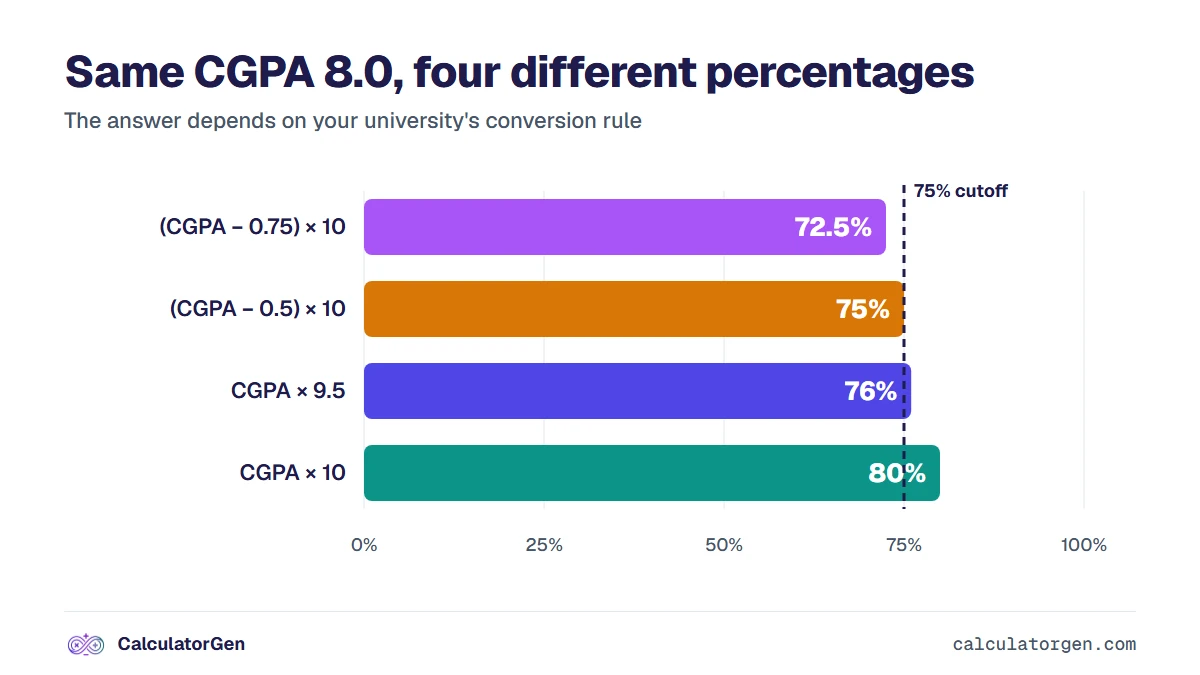
The table below shows how far apart the answers can be for the same CGPA.
| CGPA | × 9.5 | × 10 | (CGPA − 0.75) × 10 | (CGPA − 0.5) × 10 |
|---|---|---|---|---|
| 6.0 | 57% | 60% | 52.5% | 55% |
| 6.5 | 61.75% | 65% | 57.5% | 60% |
| 7.0 | 66.5% | 70% | 62.5% | 65% |
| 7.5 | 71.25% | 75% | 67.5% | 70% |
| 8.0 | 76% | 80% | 72.5% | 75% |
| 8.5 | 80.75% | 85% | 77.5% | 80% |
| 9.0 | 85.5% | 90% | 82.5% | 85% |
| 9.5 | 90.25% | 95% | 87.5% | 90% |
| 10.0 | 95% | 100% | 92.5% | 95% |
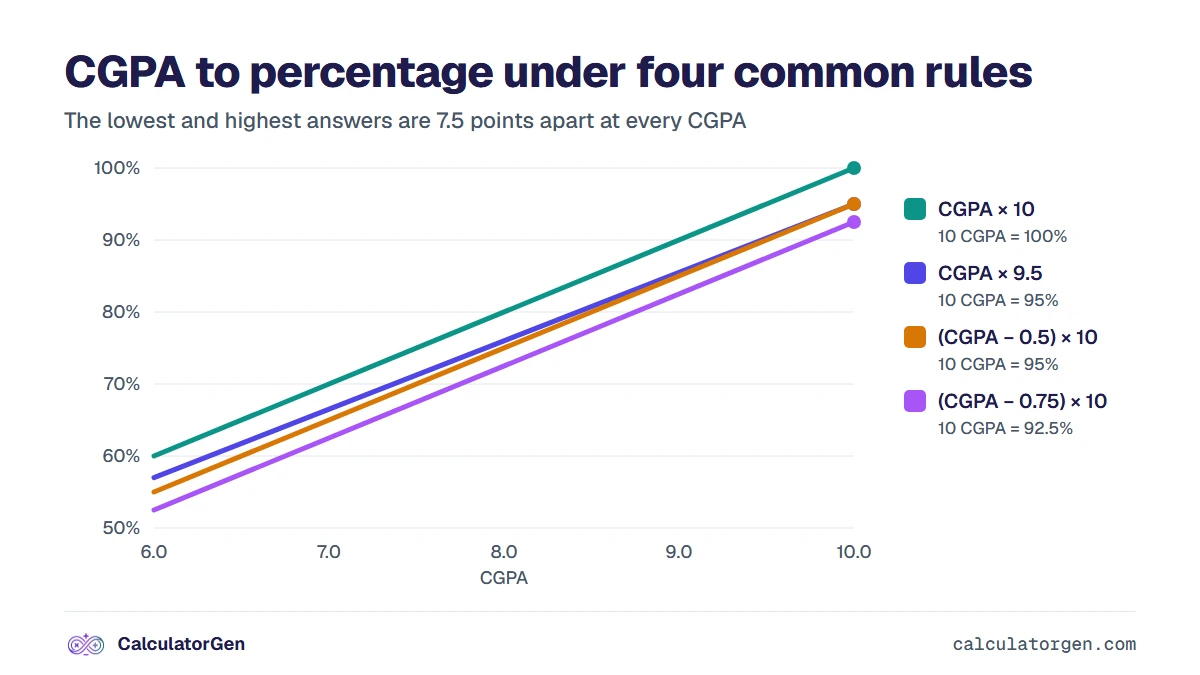
For a CGPA of 8.0, the answer ranges from 72.5% to 80%. That is a 7.5-point gap, and it is often enough to decide whether you clear a 75% cutoff.
Worked example: SGPA 8.2
Suppose your semester result is an SGPA of 8.2.
- With × 9.5: 8.2 × 9.5 = 77.9%
- With × 10: 8.2 × 10 = 82%
- With (SGPA − 0.75) × 10: (8.2 − 0.75) × 10 = 7.45 × 10 = 74.5%
The same SGPA is above a 75% cutoff under two rules and below it under the third. This is why you should never guess the rule. You can compare all three at once with the SGPA to Percentage Calculator.
How to get your CGPA from your SGPAs
If your college asks for an overall percentage, you usually convert your CGPA, not a single SGPA. If you only have semester results, work out the CGPA first:
- 1Multiply each semester's SGPA by that semester's total credits.
- 2Add these results together.
- 3Divide by the total credits of all the semesters.
Example: three semesters with SGPA 8.5 (20 credits), 8.2 (22 credits) and 8.8 (20 credits).
- 8.5 × 20 = 170
- 8.2 × 22 = 180.4
- 8.8 × 20 = 176
- Total = 526.4, and total credits = 62
- CGPA = 526.4 ÷ 62 = 8.49
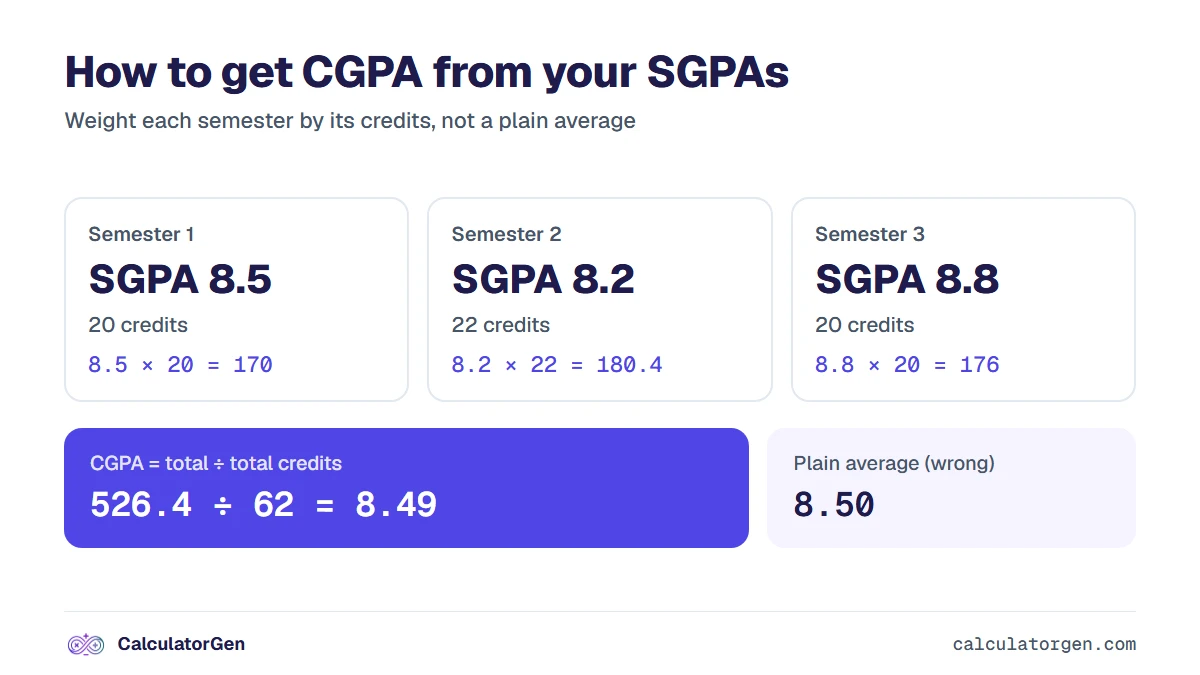
The plain average of the three SGPAs would be 8.5. It is close here, but the gap grows when semesters have very different credits. The CGPA Calculator does this weighting for you.
Going the other way: what CGPA do you need?
Many forms set a percentage cutoff, such as 60% or 75%. To find the CGPA you need, reverse your college's rule:
| Cutoff | × 9.5 rule | × 10 rule | (CGPA − 0.75) × 10 rule |
|---|---|---|---|
| 60% | CGPA 6.32 | CGPA 6.0 | CGPA 6.75 |
| 65% | CGPA 6.85 | CGPA 6.5 | CGPA 7.25 |
| 75% | CGPA 7.90 | CGPA 7.5 | CGPA 8.25 |
The working is simple. For × 9.5, divide the percentage by 9.5. For × 10, divide by 10. For (CGPA − 0.75) × 10, divide by 10 and add 0.75.
Round up, not to the nearest value. For a 75% cutoff under × 9.5, 75 ÷ 9.5 = 7.894. A CGPA of 7.89 gives only 74.96%, which misses the cutoff, so you need 7.90. The Percentage to CGPA Calculator does the reverse for you.
Which rule should you use on a placement form?
Follow this order:
- 1Your marksheet or degree certificate. If it states a conversion formula, use that formula.
- 2Your university's official notice. Search your university website for "CGPA to percentage conversion" and look for a circular or regulation.
- 3The form's own instructions. Some companies and exam bodies tell you which rule to use, or ask you to enter CGPA directly.
- 4Your college exam cell or placement office. If you still cannot find it, ask them, and keep their answer in writing.
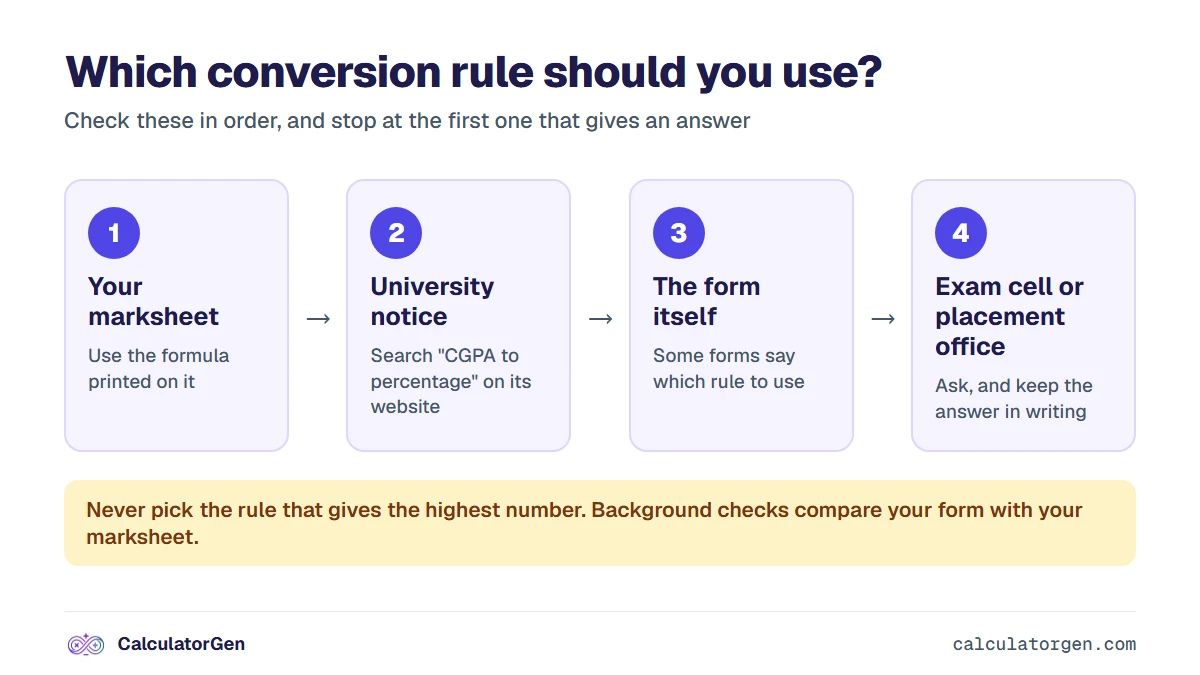
When a form allows it, write both: for example, "CGPA 8.2 (77.9% as per university conversion)". Never pick the rule that gives the highest number just because it looks better. Background checks compare your form against your marksheet, and a mismatch can cost you the offer.
Mistakes to avoid
- Averaging SGPAs without credits. Weight each semester by its credits.
- Using 9.5 for everything. It is the CBSE rule. Many universities use a different one.
- Rounding too early. Round only the final percentage, usually to two decimal places.
- Mixing scales. A CGPA on a 4-point or 7-point scale cannot use a 10-point formula.
- Expecting 10 CGPA to equal 100%. Under the × 9.5 rule, a perfect 10 is 95%.
Frequently asked questions
Is there one official formula for India?
No. CBSE uses CGPA × 9.5 for its school results, but each university sets its own rule for degree results. Always check your own university's rule.
Why does CBSE use 9.5?
CBSE chose 9.5 based on how students' marks related to their grade points in earlier exams. It is a rule for CBSE results, not a universal conversion.
Can I convert one semester's SGPA to a percentage?
Yes, with the same rule your university uses for CGPA. Most forms ask for an overall figure, though, which comes from your CGPA.
My university has no conversion rule. What do I do?
Ask your exam cell for a written answer. If there is truly no rule, many employers accept CGPA × 10 or simply your CGPA. Mention the CGPA alongside any percentage you write.
Does the percentage change after I graduate?
Your CGPA can change until your final semester. Recalculate your percentage after each semester result so your forms stay accurate.
This guide explains common conversion rules. Universities and boards set and update their own rules, so always confirm the one on your marksheet or official notice before you fill in a form.
Related Calculators & Tools
Contextual calculation tools referenced in this guide
Further Reading & Financial Guides
Deepen your understanding of borrowing and compounding mechanics